Perspectives
The Luxury of Being Unknown
Luxury spends enormous effort becoming recognisable. Yet there is another pleasure in owning, finding or understanding something that almost nobody else knows.
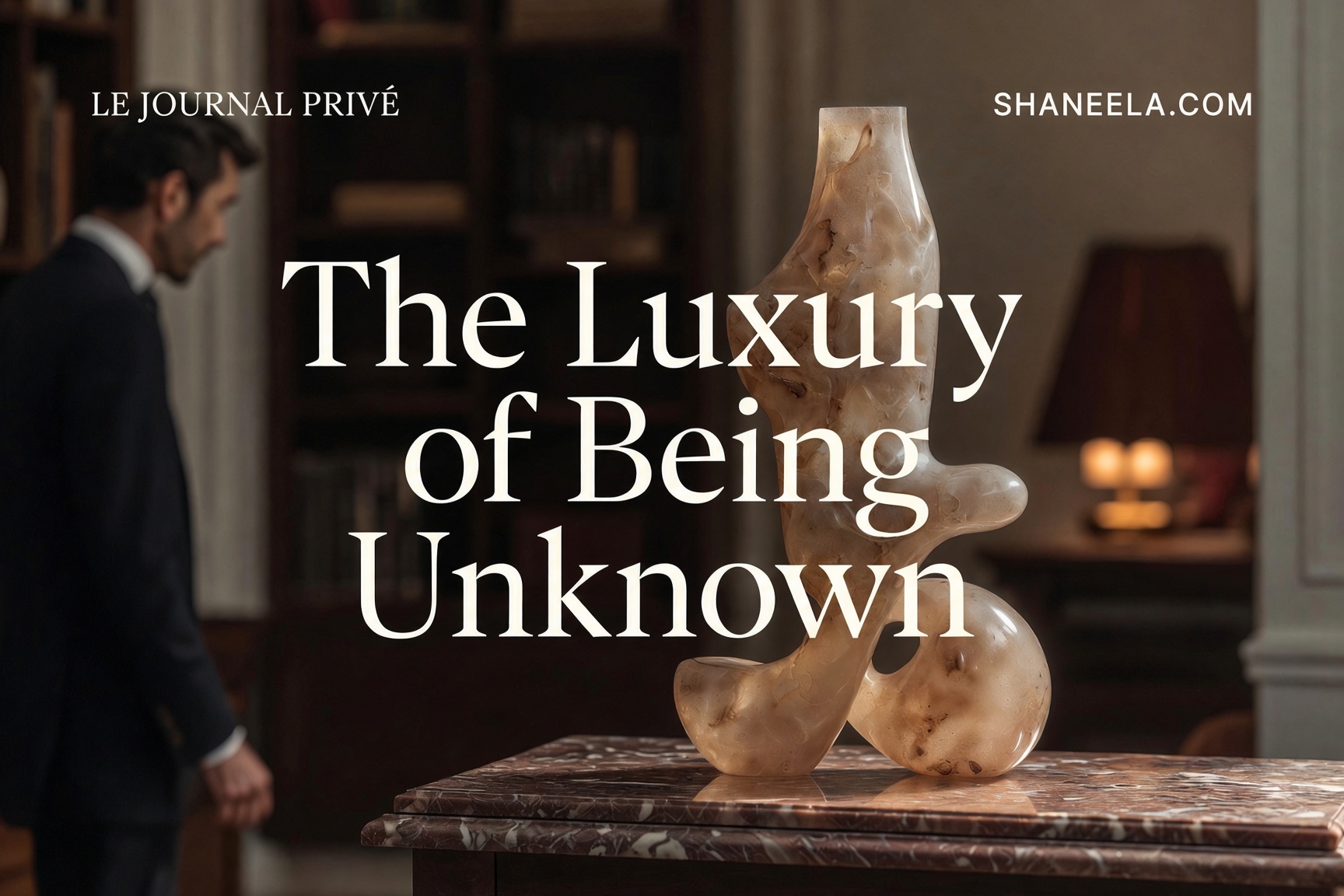
If everybody knows what you own, does it become more luxurious or less?
For much of the luxury industry, the answer appears obvious. Recognition is valuable. A house spends decades establishing its codes until a particular shape, colour, clasp or pattern can identify it before anybody sees the name.
There is considerable power in this. Recognition can carry history, reputation and an assurance of what an object represents. It also gives the owner something that can be understood by other people.
But recognition has an interesting consequence. The better known something becomes, the less knowledge is required to recognise it.
A person does not need to understand tailoring to identify a famous monogram. They do not need to know much about watches to recognise certain models across a restaurant table. An object can become so culturally familiar that almost everybody understands its significance.
Luxury has spent enormous amounts of time and money achieving this.
Yet some of the most compelling things we encounter operate in precisely the opposite way. Almost nobody recognises them.
Their value has to be discovered.
When recognition becomes explanation
There is a particular convenience in owning something whose reputation arrives before it does.
Very little explanation is necessary. The name of the maker can communicate price, prestige, craftsmanship or scarcity before anybody examines the object itself.
This is one of the great achievements of a powerful luxury house. Its name becomes a form of shorthand.
But shorthand inevitably leaves something out.
If an object is instantly recognisable, much of the encounter has already been decided. We know where to place it. We have seen other people wearing it. We may know roughly what it costs. Perhaps we have already formed an opinion about the kind of person who buys it.
The object enters the room accompanied by its reputation.
An unknown object arrives alone.
Someone may notice an unusual piece of jewellery and have no idea who made it. A beautifully constructed coat may offer no obvious clue to its origin. A fragrance might attract attention without giving the person smelling it any recognisable name to attach to the experience.
In those moments, judgement has to begin somewhere else.
Do I find this beautiful? Is it interesting? Why does it seem unusual?
Recognition answers questions before we have had the opportunity to ask them. The unknown object makes us look first.
Knowing what others do not
There is also a quiet pleasure in knowledge that is not widely shared.
Collectors understand this particularly well. Part of the enjoyment of collecting can come from developing an eye for things that other people overlook. The pleasure is not simply in possessing the object, but in understanding why it deserves attention.
This kind of knowledge cannot always be acquired immediately with money.
It takes curiosity. Sometimes it takes years.
The same is true of places. A restaurant can become desirable because everybody wants a reservation, but there is a different satisfaction in knowing the small place that has not yet appeared on every visitor's list. The pleasure comes partly from the experience and partly from having found it.
Luxury often talks about exclusivity in terms of access. Who can buy this? Who can enter? How many were made?
Knowledge creates another kind of exclusivity.
The door is not necessarily locked. Most people simply do not know that it is there.
The strange problem of success
This creates a peculiar problem for luxury businesses.
A house usually wants to become better known. Recognition brings customers, distribution, press and commercial security. Remaining obscure is not a particularly sensible objective for most businesses.
But there may be a point at which recognition changes the experience of the thing being recognised.
A hotel once passed quietly between people who knew it becomes a destination everybody has seen online. A small maker becomes internationally celebrated. An object that once prompted the question, “What is that?” begins to prompt, “Where did you get yours?”
Nothing about the quality needs to have deteriorated for the experience to change.
What has disappeared is discovery.
This does not mean that becoming successful makes something less luxurious. That would make luxury dependent upon commercial failure, which is clearly absurd.
It means that obscurity can possess a quality that success finds difficult to preserve.
The person who discovers something before it becomes widely known has a relationship with it that later customers cannot quite reproduce. They encountered it without the reassurance of widespread approval.
They had to decide for themselves.
Privacy can be part of the pleasure
There is another reason the unknown can feel luxurious.
Not everything we value needs to communicate something to strangers.
Much of modern luxury is unusually visible. We photograph restaurants before eating in them, show hotel rooms before sleeping in them and announce purchases almost as soon as they arrive. Objects that once belonged primarily to private life can now acquire a second purpose as public evidence of that life.
There is nothing inherently wrong with sharing beautiful things. But visibility changes the audience.
The moment a possession is selected partly for how it will be recognised by other people, those people become participants in the decision.
An object nobody recognises can escape some of that pressure.
Its owner may have chosen it because of the maker, the material, an encounter while travelling or simply because they loved it. If nobody else knows what it is, there is very little social reward available for having chosen correctly.
The pleasure has to come from somewhere else.
Perhaps that is why certain possessions become especially personal. Their meaning is not reinforced every time somebody recognises them. They remain largely between the object and the person who chose it.
The privilege of not explaining
There is a temptation to think that the highest form of luxury must always announce itself through exceptional rarity, expense or recognisable craftsmanship.
Sometimes it does.
But there is another possibility.
Something can be extraordinary without being widely understood. It can come from a maker whose name carries enormous significance within a very small world and almost none outside it. It can be difficult to find without being deliberately hidden.
For the person who knows, none of this reduces its value.
It may increase the pleasure of owning it.
This suggests that exclusivity and recognition are not always moving in the same direction. The more recognisable something becomes, the larger the community capable of interpreting it. The object may remain rare, but the knowledge surrounding it is no longer rare at all.
The unknown reverses this.
The object may be sitting in plain sight, yet only a few people understand what they are looking at.
There is something appealing about that form of luxury because it does not require everybody else to agree.
Perhaps the ultimate freedom is not owning something that everybody recognises and very few people can have.
It is owning something you do not need anybody else to recognise at all.