Perspectives
Who Decided Perfection Was Luxurious?
Luxury demands exceptional standards. But when does perfection become uniformity, and when does an irregularity become evidence of the human hand?
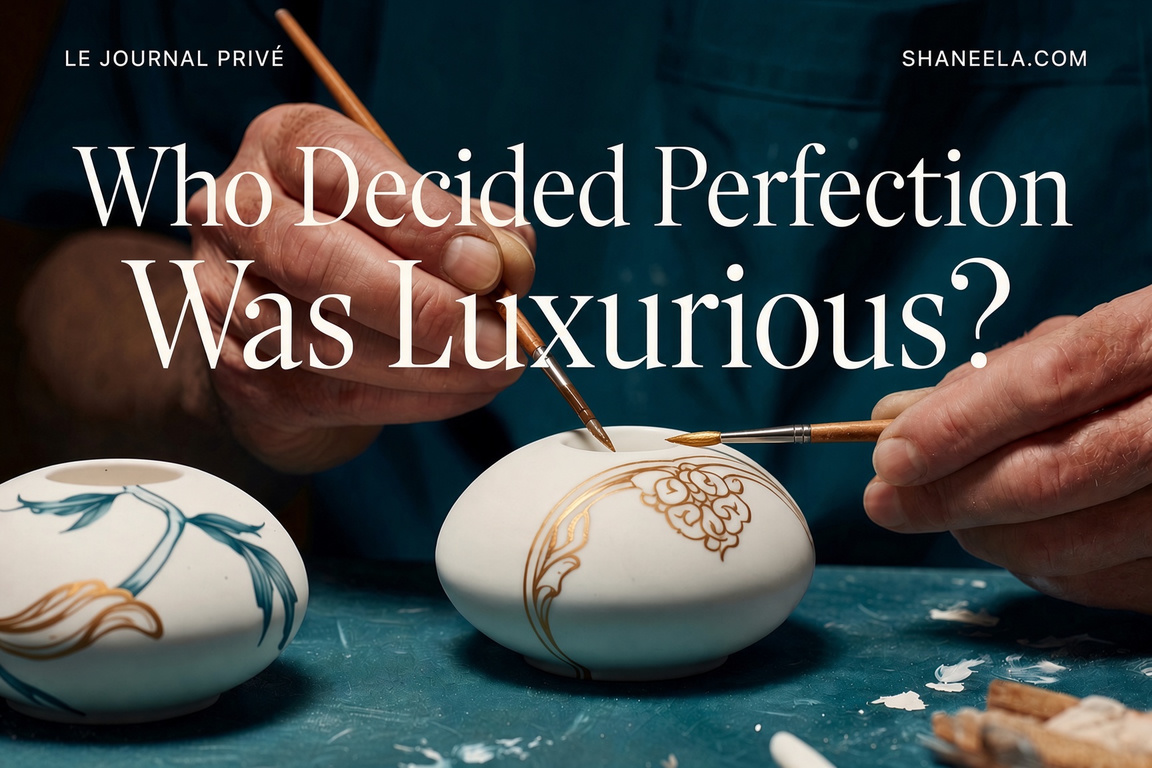
When did a flaw become evidence that something was worth less?
It seems a reasonable assumption. If two objects are otherwise equal and one is immaculate while the other carries a small irregularity, most of us would probably choose the perfect one. Luxury makes this expectation even stronger. At the highest levels of craftsmanship, we expect extraordinary precision, beautiful finishing and an attention to detail that leaves very little room for error.
We should expect those things.
A poorly finished seam does not become charming because somebody calls it handmade. A badly set stone is not evidence of authenticity. There is an important difference between the trace of a human hand and inadequate workmanship.
But somewhere between those two things, our idea of perfection becomes more complicated.
A hand-painted line may differ almost imperceptibly from the one beside it. Hand-cut crystal does not acquire its character in exactly the same way as something pressed thousands of times from an identical mould. Wood, leather and stone carry variations that existed before the maker touched them.
Remove every irregularity and we may achieve extraordinary consistency.
But at what point do we also remove the evidence that something was ever made by anyone at all?
The problem with perfect copies
Modern manufacturing is remarkably good at repetition. Machines can reproduce dimensions, surfaces and components with a consistency that would have been unimaginable for much of human history.
For many things, this is an enormous advantage. Precision matters. Reliability matters. Nobody wants the mechanical parts of an object to be charmingly approximate when their function depends upon accuracy.
Luxury, however, has a curious relationship with consistency because it often values both perfection and the human hand.
Those ideas can sit comfortably together when perfection means mastery. An experienced craftsperson can execute something with extraordinary control. Their work may appear effortless precisely because years of skill have removed mistakes that an inexperienced hand would make.
Yet mastery does not necessarily mean that every object becomes indistinguishable from every other one.
Two pieces can be made to the same exacting standard and still contain tiny differences because a person made them. The pressure of a tool changes. A brush moves slightly differently. Natural material responds in its own way. These are not failures of craftsmanship. They are consequences of making something rather than reproducing it mechanically.
We seem to understand this instinctively in some areas and resist it in others.
We admire the subtle variations in something carved by hand, then sometimes expect a handmade luxury object to possess the absolute uniformity of industrial production.
Perhaps we are asking craftsmanship to prove that it is handmade while simultaneously demanding that it conceal all evidence of the hand.
The flaw and the trace
The difficulty is deciding where imperfection ends and character begins.
Not every variation deserves to be romanticised. If an object has been carelessly made, the language of craftsmanship should not excuse it. Luxury depends upon standards precisely because materials, skill and execution matter.
But a standard does not have to mean sameness.
There is a useful distinction between a flaw and a trace.
A flaw interferes with what the maker intended to create. A trace tells us something about how it was created.
The difference may be subtle, but it changes how we see an object. A crooked construction caused by poor workmanship is a defect. The faint evidence of a tool used by an accomplished craftsperson may be part of the object's identity. Variation within natural stone is not an error in the stone. Nor is the grain of wood a problem to be corrected simply because another piece looks different.
In fact, some of the materials most associated with luxury are beautiful precisely because they refuse perfect repetition.
No two pieces of marble carry exactly the same veining. Leather develops differently according to the animal, the treatment and eventually the owner. Hand-applied finishes respond to light and surface in ways that can make tiny differences visible only when objects are placed beside one another.
Their value does not survive despite these differences.
Sometimes the differences are part of the reason we value them.
Perfection changes with time
There is another problem with our desire for immaculate things: even if perfection can be achieved, ownership immediately begins to disturb it.
The first crease appears. A polished surface develops a mark. A page is turned often enough to soften at the edge.
If perfection is the condition that makes something luxurious, then ownership gradually makes luxury less luxurious.
That seems an odd conclusion.
The objects we preserve most carefully are not always those that remain untouched. Many have been handled for generations. Historic furniture has been repaired. Jewellery has been altered to fit another wearer. Buildings regarded as architectural treasures contain the interventions of different centuries.
Their survival often depended upon somebody being willing to interfere with their perfection.
This does not mean damage should be celebrated or conservation abandoned. It means that an object's continuing life can become part of how we understand its quality.
An immaculate object can tell us how beautifully something was made.
An older one can also tell us that somebody thought it worth keeping.
What are we really paying for?
Perhaps our expectation of perfection in luxury comes partly from a reasonable desire to see evidence of effort.
When something costs considerably more than its ordinary equivalent, we expect to understand why. Better materials, greater skill, more time and stricter standards provide that explanation. A visible defect can feel like a breach of the promise.
The mistake comes when we confuse strict standards with total uniformity.
If the objective is to make every example absolutely indistinguishable, machines will often outperform human beings. That is precisely what machines are extraordinarily good at doing.
The value of the human hand must therefore lie somewhere other than its ability to impersonate a machine.
It lies in judgement. A craftsperson responds to material rather than merely processing it. They know when to continue, when to stop, when something needs correcting and when a natural variation should be allowed to remain.
That judgement can produce an object of exceptional precision without erasing its individuality.
Perhaps this is a more useful definition of perfection in luxury. Not the absence of every difference, but the absence of anything that should not be there.
What remains can still carry the maker.
An object does not need to be flawless to be exceptional
There is something reassuring about perfection when an object is new. It tells us that care was taken before it reached us.
But luxury objects are not always destined to remain in the condition in which they leave their maker.
If they are sufficiently well made, they may have very long lives. Materials will change, owners will leave traces and occasionally another skilled hand will be required to preserve what the first one created.
Perhaps the more interesting standard is not whether an object can remain flawless forever, but whether it can remain beautiful when it no longer is.
There is a considerable difference between something that deteriorates and something that ages.
The finest craftsmanship may be capable of anticipating that distinction. It creates an object precise enough to deserve its price when new, but substantial enough to survive the loss of its newness.
Perfection, then, need not mean removing every irregularity from an object or protecting it from every future mark.
It may simply mean knowing which imperfections should never have been there, and which traces deserve to remain.